Ovulation is the point in the menstrual cycle when an ovary releases a fully matured egg. This release is a key event that plays an essential role in the process of natural conception. But what happens if the ovaries fail to release an egg?
This condition is known as anovulation, one of the most significant forms of ovulatory disorder. It can affect women trying to conceive. In some cases, a woman may not realize she isn’t ovulating properly until she has trouble getting pregnant; in others, it appears as a noticeable change in her menstrual cycle.
Fortunately, there are several possible causes of anovulation, most of which are treatable. The first step in determining the right treatment plan is identifying the underlying cause of the problem.
What Does Anovulation Have to Do with Ovulation?
Anovulation occurs when an ovary fails to release a mature egg during the menstrual cycle. This is not the same as having irregular periods.
Anovulation refers specifically to the absence of ovulation, whereas irregular periods can occur even when ovulation is happening but is irregular. Ovulation is normally controlled by a carefully coordinated hormonal system involving the hypothalamus and pituitary gland in the brain, along with the ovaries.
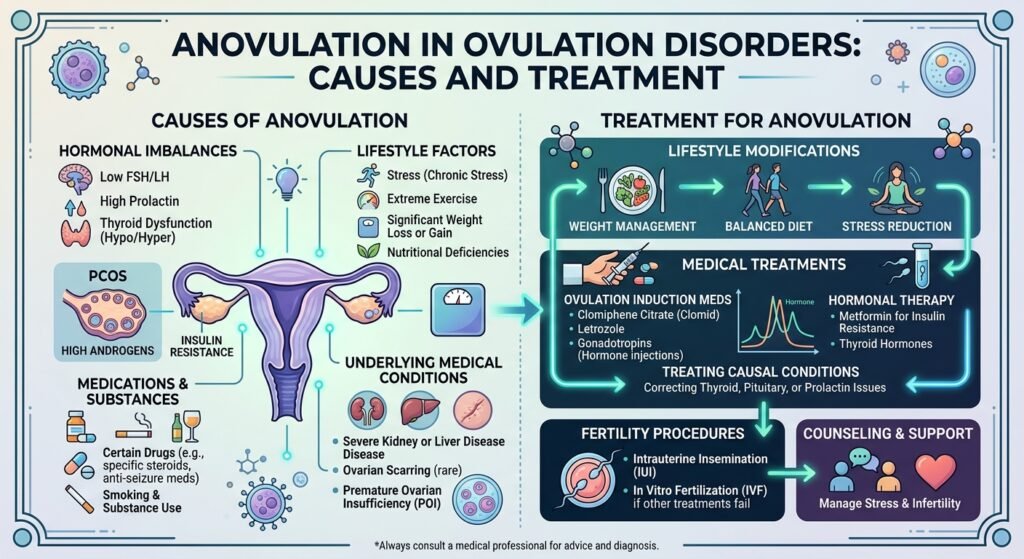
Follicle-stimulating hormone (FSH) encourages the growth of ovarian follicles, while luteinizing hormone (LH) triggers the final maturation and release of the egg. If this coordinated hormonal interaction is disrupted, the follicles may fail to develop properly, or the egg may not be released. Anovulation can be either short-term or persistent, and it can be triggered by factors such as significant weight fluctuations, intense physical activity, or hormonal imbalances.
Common Causes of Anovulation in Women
Women can experience anovulation for a number of reasons, and each woman’s experience is slightly different.
- Polycystic Ovary Syndrome (PCOS) – PCOS is the single most common cause of chronic anovulation. Hormonal and metabolic changes can interfere with normal follicle development and egg release. Women with PCOS may also experience irregular periods, acne, excess facial or body hair, thinning scalp hair, or difficulty becoming pregnant.
- Hypothalamic Dysfunction – The hypothalamus helps regulate the production of reproductive hormones. Its signaling can be disrupted by significant weight loss, poor nutrition, intense physical activity, or extreme stress, reducing the hormonal signals essential for ovulation and follicle development.
- Hyperprolactinemia- Prolactin is the hormone responsible for milk production. When prolactin levels are abnormally high outside of pregnancy or breastfeeding, it can interfere with reproductive hormones and suppress ovulation. Elevated prolactin levels can result from certain medications or underlying medical conditions, such as a pituitary tumor (prolactinoma).
- Thyroid Disorders- Both hyperthyroidism and hypothyroidism can affect reproductive hormones and the menstrual cycle. Treating the underlying thyroid condition can often help restore normal ovulatory function.
- Primary Ovarian Insufficiency (POI) – Ovulation can become irregular or stop altogether when normal ovarian function declines earlier than expected. Women under age 40 who experience a premature decline in ovarian reserve should seek a medical evaluation.
- Major Changes in Weight– Changes in energy balance directly affect the reproductive system. Very low body weight, rapid weight loss, poor nutrition, or intense exercise can impair the production of reproductive hormones. Ovulatory disorders can also result from metabolic changes associated with excess weight.
- Other Factors – Certain medications and chronic illnesses can also impair reproductive function. Because anovulation can have many possible causes, a healthcare professional should evaluate ongoing symptoms rather than assuming a single condition is responsible.
Warning Signs of Anovulation
Anovulation can present with a wide range of signs. A change in the menstrual cycle is among the most noticeable indicators of the condition.
When a woman is not ovulating, she may notice some of the following symptoms:
- Irregular or missed periods
- Infrequent periods
- Prolonged menstrual cycles
- Heavy or unpredictable bleeding
- Variable menstrual flow
- Difficulty getting pregnant
However, menstrual bleeding alone doesn’t tell the whole story — some women continue to bleed even when they are not ovulating.
Additional signs may appear depending on the underlying cause.
For example, a woman with a thyroid condition might notice changes in body weight, energy levels, or temperature sensitivity, while a woman with PCOS may experience acne or excess hair growth. Some women have no symptoms at all and only discover they have anovulation during a fertility evaluation.
Can You Have a Period without Ovulation?
Yes.
This is an important distinction. Although related, ovulation and menstruation are not the same thing. A woman can continue to have monthly uterine bleeding even without regular ovulation, which means that a monthly period does not necessarily indicate that ovulation occurred. A doctor can run appropriate tests to determine whether ovulation is taking place.
How Anovulation Can Affect Fertility?
The connection between anovulation and fertility is straightforward: an egg must be released for fertilization — and therefore pregnancy — to occur. During a normal cycle, ovulation releases a mature egg that can meet sperm in the fallopian tube.
If no egg is released during a cycle, fertilization cannot occur. Women who ovulate infrequently can still become pregnant, though conception may take longer because there are fewer opportunities for ovulation. Anovulation can also make it harder to track fertility.
Tracking cycle length alone isn’t a reliable way to identify the fertile window when ovulation is irregular or absent. However, anovulation does not always lead to permanent infertility — some women regain ovulation once the underlying cause is treated, while others benefit from ovulation-induction medications or assisted reproductive technologies.
Anovulation, Infertility, and PCOS
PCOS deserves special attention because anovulation is a leading cause of infertility in women with the condition. In PCOS, ovarian follicles can begin to grow but may not develop fully enough to trigger ovulation, resulting in irregular or absent egg release. This does not mean that women with PCOS cannot become pregnant.
Although many women with PCOS can conceive naturally, some may benefit from ovulation induction or assisted reproductive treatment. A woman’s age, reproductive goals, overall health, and any additional fertility factors all influence the best course of action.
Anovulation Care at NJINSKY IVF & Fertility Clinic
Identifying the underlying cause of anovulation is often more important for women affected by it than simply correcting the menstrual cycle. Menstrual irregularities, ovulatory problems, hormonal issues, and infertility can all be evaluated individually at NJINSKY IVF & Fertility Clinic.
Evaluation may include ovulation monitoring, fertility planning, hormonal screening, and ultrasound imaging, based on the individual’s circumstances. Depending on the patient’s reproductive needs and clinical condition, additional options such as ovulation stimulation, IUI, IVF, ICSI, and standard embryo transfer may also be considered as part of a more advanced treatment plan.
Whether the goal is to increase the chance of conception, restore natural ovulation, or move toward more advanced treatment, a tailored treatment plan can be developed to meet that goal.
In Conclusion
Could irregular menstruation or difficulty getting pregnant be triggered by anovulation? It’s certainly a factor, but not the only one.
PCOS, hormonal imbalances, weight changes, excessive physical activity, dietary factors, and numerous other conditions can all contribute to anovulation. It’s important to remember that anovulation does not mean pregnancy is impossible.
Once the underlying cause is identified, treatment can be tailored to help restore ovulation and improve the chance of conception. If it’s taking longer than expected to get pregnant, or your periods have been consistently irregular, a professional evaluation can help you get the answers you need and determine the best course of action.