A hormone that is more often associated with male development, strength of the muscles, and sexual libido…could this hormone be causing problems related to fertility?
The answer to this is more complicated than it appears to be. Libido, energy levels, muscle development, and sexual wellness are all often associated with testosterone. But, it also additionally serves as a key part within testes, in which it helps in the formation of sperm.
Therefore, it naturally raises this concern: is it more challenging for a male individual to become a father when he has low testosterone?
While some men who have fertility-related issues might be suffering from low levels of testosterone, frequently known as testosterone deficiency or hypogonadism, when it corresponds with appropriate clinical signs, low testosterone levels do not, however, consistently signify inadequate sperm production.
In fact, research has indicated that there may be more to the connection between testosterone concentration and quality of the semen than simply the fact that “low levels of testosterone equates to low quality sperm”.
It is important to fully understand this difference because medications to boost testosterone levels could have an impact on the production of the sperm.
Common Reasons For Men’s Low Testosterone
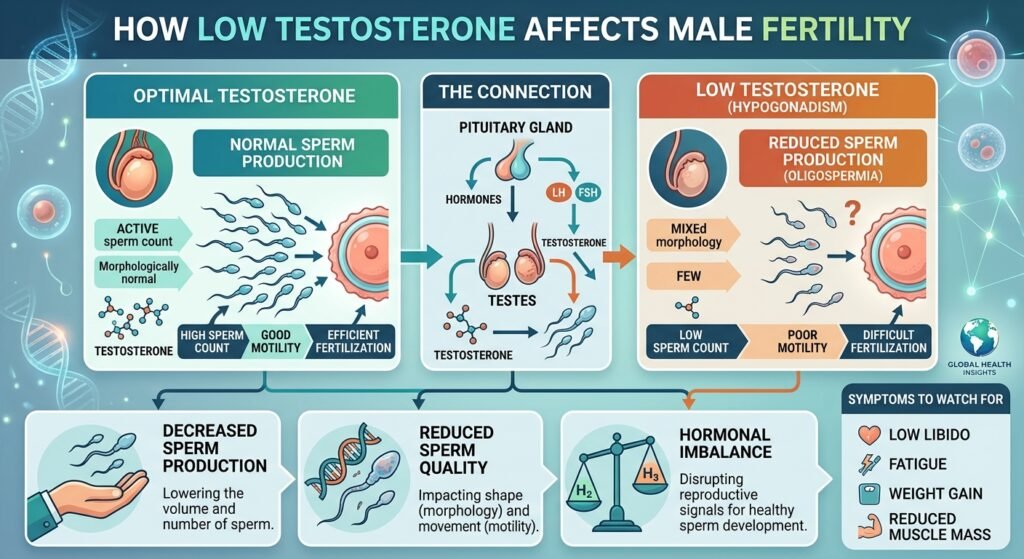
Complete and coordinated connection between the brain, the pituitary gland, and the testes is absolutely necessary for the production of testosterone. Hormonal signals like release of luteinizing hormone (LH), which stimulates the Leydig cells of the testes to produce testosterone, are regulated by the ability of the pituitary gland and hypothalamus to function properly. Low testosterone can be a result of several problems at various stages of this connection.
Some of the potential causes are:
- Conditions related to testicles: The production of testosterone may be affected by injury, bacterial infections, trauma, or certain other disorders affecting the testes.
- Pituitary gland and hypothalamic disorders: Disruption in the brain’s hormonal signals may diminish testicle stimulation.
- Some other medical conditions: A lack of testosterone might sometimes be associated with metabolic disorders and chronic medical conditions.
- Certain Medicines: Some medications might cause problems in hormonal balance and synthesis of the testosterone hormone.
- Genetic Conditions: Proper hormonal and testicular activity might be impaired by some abnormalities in the genes.
- Consumption of anabolic steroid drugs: Anabolic androgenic steroids may disrupt sperm formation and diminish the human body’s natural reproductive hormonal cascade.
Discovering the root of the problem can frequently be more effective than focusing on just the testosterone levels since low levels of testosterone may have numerous causes.
Signs and Symptoms of Low Testosterone
How would you know if your testosterone levels were low?
Men usually express an extensive variety of signs, some of which are those which might show up slowly.
Listed below are some of the potential warning signs of deficiency of testosterone:
- Diminished libido
- Issues with maintaining the erection
- Low stamina and tiredness
- Low muscle strength
- Mood fluctuation
- Body and face hair loss
- Problems with conception
- Weak erection
- Changes in testicle size
The effects of stress, lack of sleep, being overweight, recurrent sickness, illicit drugs, and other hormonal related problems may also result in many of these symptoms. Therefore, low testosterone cannot be confirmed by symptoms alone.
Rather than depending only on signs and symptoms of low testosterone or clinical lab outcomes, seeking a thorough evaluation will altogether address all of the warning signs, clinical data, and sufficient hormone testing.
How Low Testosterone May Be Affecting Fertility and Sperm Quality?
This marks the stage during which the connection becomes truly fascinating.
Follicle-Stimulating Hormone (FSH) along with Luteinizing Hormone (LH) act on the testes: LH stimulates the production of the high concentration of testosterone inside the testes that is required for sperm production, while FSH acts on the Sertoli cells to support spermatogenesis. Alongside these hormonal signals, testosterone produced in the testes helps stimulate spermatogenesis.
This indicates that having a relatively low blood testosterone level fails to offer an accurate overview of sperm generation. However, taking testosterone is not the same as a fertility medicine.
When a person takes testosterone from outside sources, the pituitary gland may reduce its release of LH and FSH in response. This can lower the level of testosterone inside the testes, which is considered essential for production of sperm.
Azoospermia, the complete absence of sperm in the semen, can develop when a man’s sperm production drastically decreases or stops altogether. Thus, a man who feels anxious about low levels of testosterone and fertility should not start taking testosterone booster drugs on his own.
The Diagnosis And Possible Treatment Choices For Low Testosterone
The initial stage is learning about why the testosterone hormone is low and whether or not sperm production is also influenced by it. The physician may review the symptoms, medications, lifestyle habits, and reproduction history.
Based on the situation, evaluation may involve hormonal testing such as testosterone, FSH, LH and at times prolactin. A thorough sperm/semen analysis can aid in finding out how sperm quality and quantity, motility, and other semen factors have been affected. Your course of treatment depends on the root cause of the problem and the intent to conceive.
As a first step, try seeking treatment for underlying problems which may be contributing to low testosterone levels. Some specialists may consider recommending human chorionic gonadotropin (HCG), selective estrogen receptor modulators (SERMs) or aromatase inhibitors to preserve fertility through treatment.
Is Testosterone Replacement Therapy a Good Option?
Considering that testosterone monotherapy may inhibit sperm generation, it is not suggested for men who are actively trying to conceive. Exogenous testosterone should not be offered to men who want to conceive now or in the future, according to clinical guidelines.
This does not mean that all men with low levels of testosterone should entirely disregard the proper treatment. Instead, before taking the treatment, fertility objectives are required to be discussed with a professional.
Role of NJINSKY IVF & Fertility Clinic in Treatment Approaches
A lack of testosterone could result in an impact on fertility along with energy levels and reproduction wellbeing. Men with male factor infertility have the option to evaluate their semen factors and fertility associated components at NJINSKY IVF & Fertility Clinic.
Based on the outcomes, consulting with an andrologist, urologist, and fertility professional may assist you to pinpoint whether impotence has actually been triggered by hormonal imbalance, insufficient sperm production, or some other issue.