Even though facial hair is perfectly normal to have. But it can sometimes point to a deeper hormonal imbalance where the facial hair grows darker and thicker. Excessive facial hair might be one of the most bothersome symptoms for many individuals with PCOS, not mainly because of its physical appearance but given that it may serve as an indication for something that is intrinsic in the body may not be functional like it should.
Hirsutum is a condition in which women develop thick, black hair in places like the chin, upper lip, belly, and in places where hair growth is more often influenced by male hormones, usually associated with facial hair growth during PCOS.
Yet, you are rarely diagnosed with PCOS, if you have facial hair. In conjunction to genes, ethnic origin, medications, and other hormonal variables, women’s hair production can vary significantly. Even so, it is essential to seek advice from a medical professional.
What leads to Excessive Facial Hair Growth in Women with PCOS?
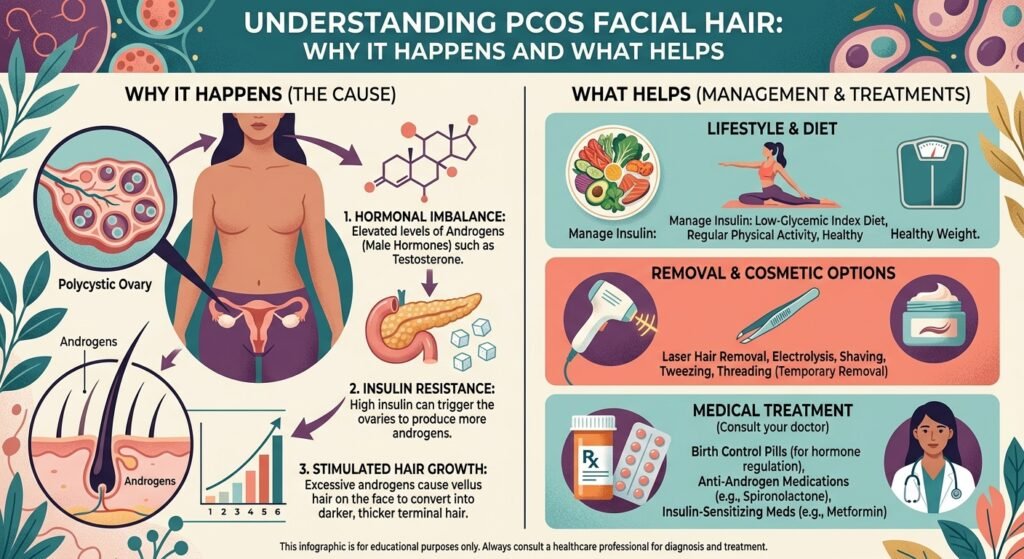
Excessive production of androgen hormone, also known as Male Hormone, is the most common cause of facial hair in PCOS. Though, women naturally produce androgens but having PCOS can elevate the levels of androgen production and raise the sensitivity of hair follicles in response to this effect. Androgens have the tendency to impact hair follicles, darkening and thickening the thin normal slightly colored hair. This process is referred to as terminal hair growth.
Insulin metabolism can additionally be influenced by PCOS. It is common to have insulin resistance in such conditions and high levels of insulin might serve as a factor in over production of androgen in ovaries. This creates a hormonal condition that might encourage the development of excessive hair. Most importantly, not every female shares a similar connection to PCOS and Hirsutism. Though some women with PCOS have an excessive amount of facial hair growth, many others have barely any.
Typical Symptoms of PCOS-related Facial Hair
The presence of thick, coarse black hair, where women typically possess normal fine hair is one of the greatest prominent signs of PCOS associated facial hair. Hair could begin to grow or appear more noticeable in certain areas;
- Jawline
- Upper Lip
- Chin
- Area of side burn
- Neck
- Chest
- Abdominal area
There might be a gradual progressive pattern. After you notice a couple of chin hairs in the beginning, you might notice these hair follicles becoming thicker and darker, and require to be plucked out more often. A few chin hairs by themselves, still, should not be taken as a confirmation of PCOS. It is quite normal for women to grow some facial hair particularly as they grow older.
Abnormal hair growth in terms of PCOS, happens together with other symptoms such as irregular menstrual cycle, acne that never goes away, hair scalp thinning, and difficulty getting pregnant.
Why Is Facial Hair Growth Caused By Hormonal Imbalance?
Hormone sensitive receptors are present in hair follicles. The developmental process and characteristics of hair in different body parts can be impacted by androgens. Hair follicles in androgen sensitive areas may produce thicker and dark colored hair, where androgen production is elevated.
This explains why a woman could experience the following simultaneously;
- Thickened facial hair
- Hair thinning
- Persistent acne
- Oily/ greasy skin
At first, these signs may not appear to be related but androgen production may influence all of these. PCOS can not be the only sole cause of the androgen associated hirsutism, though it is one of the most common.
Abnormal hair growth can also be triggered by thyroid problems, some medications, adrenal issues, and other hormonal conditions. For this purpose, addressing your hair alone is not as effective as finding the root cause.
Do Every PCOS Affected Women Get Facial Hair Problems?
No. PCOS is very unexpected.
While some women solely go through metabolic issues or menstrual irregularities, others experience severe hirsutism. Genetics and the susceptibility of growth of specific hair follicles to androgen levels, additionally affect the overall amount of facial hair. Because women’s facial hair are particularly sensitive to such hormones, you can possess normal levels of androgen but still experience considerable growth of hair.
Likewise, a woman diagnosed with PCOS might not have any facial hair whatsoever.
In this regard, rather than being considered a single diagnosis, excessive hair on the face should be taken seriously together with the rest of the symptoms shown in the women.
Evaluation of PCOS associated Facial Hair
A medical specialist might ask about your period cycle, medical record, prescribed drugs, weight changes, acne, hair growth pattern, or if the growth of unwanted hair is new, growing quickly, and is associated with other hormonal symptoms.
Blood testing to determine levels of androgen and clear out other hormonal conditions which may be suggested according to the specific situation.
Experienced specialists may also evaluate the following symptoms;
- Disturbed menstrual cycle
- Acne
- Hair thinning
- Weight fluctuations
- Conception difficulties
The primary objective is to assess the exact reason of what is triggering the excess facial hair growth, not just diagnosed with PCOS.
Acute hirsutism or other symptoms of considerable amounts of androgens must be ruled out by a doctor real quick.
Treatment Options for Facial Hair Caused By PCOS
Not one particular treatment works well for every woman. The degree of severity of hair growth, more PCOS symptoms, the desire of conception, and individual’s health condition all contribute to the most effective course of action.
- Cosmetic Hair Removal – Includes Waxing, Threading, Plucking and Shaving
- Laser Hair Removal – For long term reduction in hair growth
- Medications – Can help regulate hormone levels
- Treatment for Insulin Resistance and Metabolic health
Avoid Unapproved ‘Hair Removal’ Remedies
Stories about at home treatments that are intended to completely remove facial hair are circulating all over social media. Though, diy facial masks, spice blends, plain lemon shots, and other remedies might temporarily alter the look of the skin or hair, they are not recommended to be treatments techniques for hormonal disorder such as hirsutum. Furthermore, particular products may lead to hyperpigmentation and cause irritation on the skin of the face.
Complete PCOS and Fertility Care at NJINSKY IVF & Fertility Clinic
Considering treatment outside of the cosmetic nature of the issue and focusing on the hormonal factors behind the symptoms of this medical condition may be advantageous for women with PCOS who exhibit facial hair.
Women with PCOS associated problems like irregular menstrual cycle, ovulation problems, and fertility problems may have a reproductive and hormonal assessment at NJINSKY IVF & Fertility Clinic.
Hormonal testing, monitoring of the ovulation, fertility examination, and tailored treatment can be all part of the treatment approach, based on the necessities of each patient. When clinical feasible, fertility treatment including ovulation inducement, IUI, IVF, ICSI, and standard ovulation transfer may be suggested for women whose PCOS hinders their ability to conceive.
Recognizing the broader hormonal and reproductive issues and adapting proper care to each woman’s specific needs is the goal in comparison to just treating one evident symptom.
Finally
It is crucial to keep in mind that facial hair does not define your health or femininity, even if it might be an understandably annoying aspect of PCOS. It can be controlled in a number of ways and is frequently caused by the way hair follicles react to androgen activity.
While medical treatment can assist to address the hormonal factors that contribute to new growth, cosmetic techniques can remove existing hair. Another evidence-based treatment for women with PCOS-related face hirsutism is laser hair removal.
Instead of only treating the hair on the surface, think about getting evaluated if undesired hair coexists with irregular periods, acne, thinning scalp hair, or fertility issues. Finding the root problem might lead to more individualized, successful management.