One of the most frequently occurring reproductive and hormonal conditions impacting women of reproductive age is Polycystic Ovary Syndrome (PCOS). Still, many people presume that PCOS and PCOD are the same disorders. The terms are often used interchangeably, although they do not have exactly the same meaning in all contexts.
PCOS is a well-established medical condition, while PCOD (Polycystic Ovarian Disease) is a term that is still commonly used in some countries but is not a separate, universally recognised diagnosis in current international PCOS guidelines.
Understanding the difference between the commonly used terms PCOS and PCOD can help women better understand their symptoms, diagnosis, fertility, and available treatment options. Timely medical assessment and appropriate care can help women manage their symptoms and protect their long-term health.
The meaning of PCOD, what PCOS is, their commonly described differences, symptoms, diagnosis, treatment options, and when to seek medical advice will all be addressed in this blog.
PCOD: What is it?
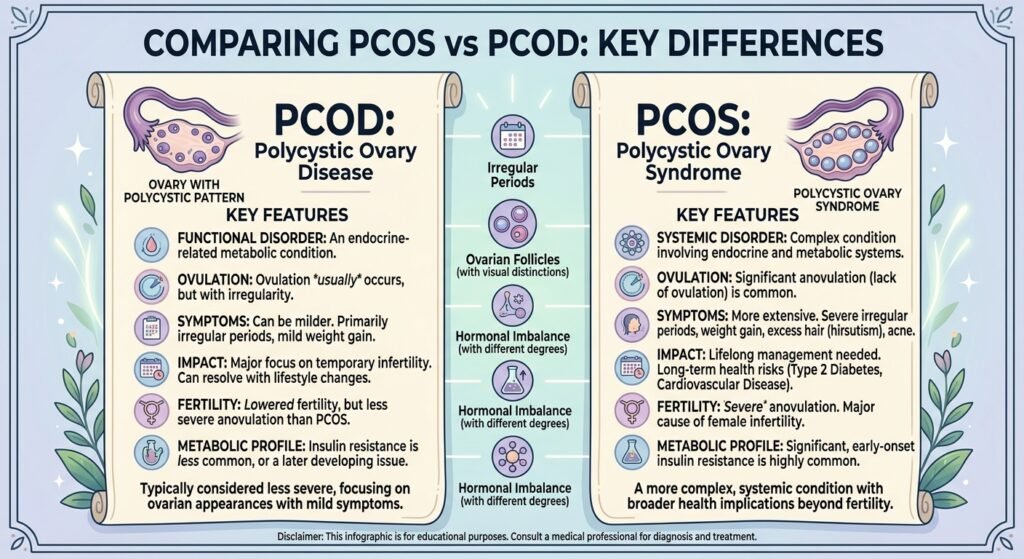
PCOD, or Polycystic Ovarian Disease, is a term commonly used to describe a pattern of hormonal or ovulatory problems involving the ovaries. It is often associated with multiple small follicles, irregular periods, and difficulties with ovulation.
However, it is important to understand that PCOD is not considered a separate, clearly defined medical condition from PCOS in current international guidelines. The term is still commonly used in everyday healthcare discussions, particularly in South Asia, but healthcare professionals generally use PCOS as the recognised diagnosis.
Women with features sometimes described as PCOD may still ovulate and may be able to conceive naturally. The appropriate assessment depends on the individual’s symptoms, medical history, hormonal profile, and reproductive goals.
Introducing PCOS
Polycystic Ovary Syndrome is a complex hormonal and metabolic condition that can affect ovulation, menstrual cycles, androgen levels, fertility, and overall health.
Women with PCOS may experience:
- Irregular or absent ovulation
- Increased androgen activity
- Irregular menstrual cycles
- Difficulty becoming pregnant
- Metabolic concerns such as insulin resistance
PCOS can affect more than the reproductive system and is also associated with an increased risk of certain metabolic and psychological health concerns.
PCOS vs PCOD
The comparison below can help explain why the two terms are often confused:
PCOD | PCOS |
Commonly used term for ovarian and hormonal irregularities | Established medical diagnosis |
May be used to describe irregular ovulation and multiple ovarian follicles | Can involve ovulatory dysfunction, increased androgen activity, and polycystic ovarian morphology |
Not a separate universally recognised diagnosis | Recognised in international clinical guidelines |
May be associated with fertility difficulties | Can be associated with infertility due to irregular ovulation |
The term is commonly used in some countries | Used internationally by healthcare professionals and clinical guidelines |
Rather than considering PCOD and PCOS as two completely different disorders, it is more accurate to understand that PCOD is a commonly used term, while PCOS is the recognised clinical condition.
The Main Difference Between PCOD and PCOS
The main difference is therefore related to how the terms are used rather than two completely separate diseases.
1. Medical Definition
PCOS is a recognised hormonal and metabolic condition with established diagnostic criteria.
PCOD is a term that is often used to describe certain ovarian or hormonal features but does not have a separate, universally accepted diagnostic definition.
2. Ovulation
Irregular ovulation can occur in women with PCOS and may make conception more difficult.
Women described as having PCOD may also experience irregular ovulation. However, the effect can vary significantly from one woman to another.
3. Fertility
Both terms may be associated with difficulties in becoming pregnant when ovulation is irregular.
However, having PCOS does not mean that pregnancy is impossible. Many women with PCOS conceive naturally, while others may require fertility treatment depending on their individual circumstances.
Treatment options can include ovulation induction, intrauterine insemination (IUI), and in vitro fertilisation (IVF) where appropriate.
4. Metabolic Health
PCOS is associated with several metabolic concerns, including:
- Insulin resistance
- Increased risk of type 2 diabetes
- Abnormal cholesterol levels
- High blood pressure
- Increased cardiovascular risk factors
These risks can vary between individuals. It would not be accurate to assume that women described as having PCOD are automatically free from these concerns.
PCOD and PCOS Overlapping Symptoms
The symptoms can overlap considerably, which is one reason the two terms are often confused.
Common symptoms may include:
- Irregular menstrual cycles
- Acne
- Oily skin
- Weight changes
- Thinning scalp hair
- Excess facial or body hair
- Difficulty becoming pregnant
- Multiple follicles seen on ultrasound
Women with PCOS may also experience metabolic concerns, insulin resistance, or psychological symptoms.
However, symptoms alone cannot confirm a diagnosis of PCOS. A healthcare professional needs to assess the overall clinical picture.
Most Likely Causes of PCOD and PCOS
There is no single established cause of PCOS. Current research suggests that genetic, hormonal, metabolic, and environmental factors may all contribute.
Possible contributing factors include:
- Genetic factors
- Hormonal factors
- Insulin resistance and metabolic factors
- Environmental influences
The exact combination of factors can vary between individuals, which is why PCOS can present differently from one woman to another.
Options for Treatment
The treatment strategy depends on the woman’s symptoms, overall health, and reproductive goals.
Some general management options include:
- Lifestyle changes – Regular physical activity, a balanced diet, adequate sleep, and maintaining a healthy weight where appropriate can support overall metabolic health and help manage some PCOS symptoms.
- Medications – Depending on individual needs, specialists may recommend medicines to regulate menstrual cycles, manage androgen-related symptoms, improve metabolic health, or support ovulation.
- Fertility treatment – Women experiencing difficulty conceiving may benefit from treatments such as ovulation induction, IUI, IVF, or ICSI where clinically appropriate.
The woman’s age, symptoms, reproductive goals, and overall health all contribute to the most suitable treatment strategy.
Can PCOD Turn into PCOS?
It is a common misconception that PCOD always develops into PCOS.
Because PCOD is not a separate, universally recognised diagnosis, it is more accurate to say that a woman who has symptoms commonly described as PCOD may later meet the diagnostic criteria for PCOS, or may already have PCOS that has not yet been formally diagnosed.
A healthcare professional can assess symptoms, medical history, hormone levels, and other relevant findings to determine whether PCOS is present.
Complete Treatment Care at Top Clinic
At NJINSKY IVF & Fertility Clinic, women experiencing symptoms associated with PCOS or other reproductive concerns can benefit from comprehensive assessment and personalised care.
The clinic provides hormonal assessments, pelvic ultrasound, ovulation monitoring, fertility screening, and tailored treatment plans as part of its reproductive healthcare services.
NJINSKY IVF & Fertility Clinic also offers reproductive procedures including ovulation induction, IUI, IVF, ICSI, and embryo transfer for women experiencing difficulties with conception, depending on their individual clinical needs.
The clinic’s experienced gynaecologists and fertility specialists focus on personalised, evidence-based care designed around each patient’s reproductive circumstances and goals.
Ending Remarks
Understanding the difference between PCOS and PCOD can be confusing because the two terms are often used interchangeably, particularly in everyday discussions.
PCOS is the recognised clinical condition, while PCOD is a term commonly used in some countries to describe certain ovarian or hormonal features. The symptoms can overlap, and an accurate diagnosis should be based on appropriate medical assessment rather than terminology alone.
If you experience irregular periods, hormonal changes, difficulty becoming pregnant, or other symptoms associated with PCOS, it is important to consult a qualified gynaecologist or fertility specialist.
With appropriate medical care, lifestyle measures, and an individualised treatment strategy, many women with PCOS can successfully manage their symptoms, support their reproductive health, and maintain a healthy and active life.