Many women experience pelvic pain, heavy menstrual bleeding, and problems with conception; however, identifying the exact cause can be very challenging. Endometriosis and adenomyosis are two separate medical conditions that are sometimes confused with one another. These are entirely different disorders that affect distinct parts of the reproductive organs, even though they exhibit similar signs and symptoms.
Learning about endometriosis and adenomyosis is important because a precise diagnosis allows women to obtain the best possible treatment and improve their quality of life. This article discusses the symptoms, underlying causes, diagnosis, and treatment options for both endometriosis and adenomyosis, as well as their potential impacts on fertility.
Endometriosis
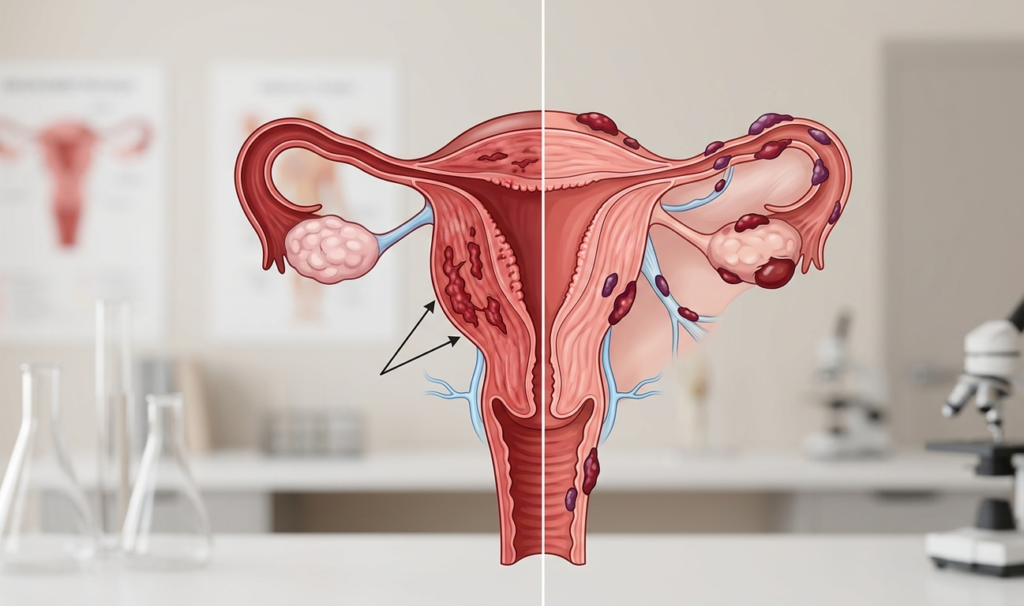
Endometriosis is a medical condition in which tissue similar to the uterine lining grows outside the uterus. This tissue can be found on the fallopian tubes, ovaries, pelvis, and other surrounding organs. Like the normal uterine lining, these tissues respond to hormonal changes during the menstrual cycle, leading to bleeding, inflammation, and scar formation.
But since these tissues and old blood can not seem to exit the body, they could cause adhesions, scarring, inflammation, and chronic pelvic discomfort. One of the primary causes of infertility, Endometriosis mainly impacts women during their reproductive ages.
Signs and Symptoms of Endometriosis
Women affected with endometriosis might experience the following;
- Extreme menstrual cramps
- Persistent pelvic pain
- Ovulation-associated pain
- Pain during intercourse
- Pain during bowel movement or urination
- Chronic fatigue or infertility
The level of pain may not always correspond with the severity of the disorder, and signs may vary widely.
Adenomyosis
Adenomyosis is a condition in which tissue similar to the uterine lining grows into the myometrium (the muscular wall of the uterus). Unlike endometriosis, the abnormal tissue remains within the uterus, causing the uterine wall to thicken and become enlarged. This can result in inflammation and increased uterine contractility.
Common signs of adenomyosis in women include heavy and painful menstrual periods, pelvic pressure and pain, and painful intercourse. Although adenomyosis can occur at any age, women between 30 and 50 years old are more frequently diagnosed with this condition.
Signs and Symptoms of Adenomyosis
- Chronic and heavy menstrual bleeding
- Painful periods
- Pressure in the pelvic region
- Enlarge uterus
- Pain in the lower back
- Pain during intercourse
Adenomyosis may be found after ultrasound imaging or surgery in some women who do not exhibit any symptoms at all.
The Difference Between Endometriosis and Adenomyosis
The key difference between endometriosis and adenomyosis lies in the location where the atypical tissue grows.
Endometriosis | Adenomyosis |
Tissues develops on the lining of the uterus(outside the uterus) | Tissues develop within the myometrium(muscular wall) of the uterus. |
Effect: Ovaries, Fallopian Tubes, Bladder, Bowel Movement, and Lining of the pelvic region | Effect: Limited to uterus |
Causes: Adhesions/lesions and Ovarian Cysts | Causes: Enlarge uterus(uterus expands) |
Often associated with fertility issues | Can affect fertility health but is related to heavy bleeding and discomfort |
Adenomyosis vs Endometriosis, although both of these have important key differences, however both medical conditions may occur with similar signs and symptoms, making diagnosis challenging.
Can You Have Both Conditions?
Actually, yes.
Adenomyosis and endometriosis can be both diagnosed simultaneously in women. The subsequent symptoms can get worse when both conditions coexist;
- Intense cramping during menstrual period cycle
- Significant and heavy bleeding
- Persistent pelvic pain
- Pain during intercourse
- Difficulty getting pregnant
As the treatment might be required to treat both the disorders at the exact same time, accurate diagnosis is necessary.
Causes and Risk Factors
The exact cause of both the disorders is still unknown. Researchers believe that a variety of different things could be related such as;
- Hormonal changes
- Genetic changes
- Chronic inflammation
- Uterine surgery of the past(more likely related to adenomyosis)
- Immune system abnormalities
Both diseases are affected by estrogen hormone, regardless of different root causes.
How Do They Get Diagnosis?
Imaging and clinical evaluation are often utilized in combination with diagnosis of these disorders. Specialists may suggest;
Since, these measures can show the abnormalities in the uterine muscle, ultrasonography, and MRI are extremely useful in detecting adenomyosis.
Adenomyosis and Endometriosis Relation with Fertility Health
Endometriosis is more closely linked to fertility health because it can effect;
- The ovaries
- The fallopian tubes
- Quality of eggs
- Pelvic structure
Although many women with adenomyosis can conceive successfully, this disorder may reduce fertility by affecting implantation or altering the uterine environment. Early diagnosis is important because fertility outcomes can be significantly affected when both conditions coexist.
Women’s Health and NJINSKY IVF & Fertility Clinic
At NJINSKY IVF & Fertility Clinic, women affected with endometriosis or adenomyosis who are experiencing infertility may benefit from a comprehensive assessment. In an effort to identify and manage complex reproductive disorders, this clinic integrates the expertise of gynecologists and fertility experts.
Comprehensive fertility assessments, reproductive ultrasound imaging, tracking of the ovulation, hormonal evaluation, IVF, IUI, ICSI and standard embryo transfer are all the services provided by NJINSKY IVF & Fertility Clinic.
This medical facility develops personalized treatment regimens considering the symptoms, fertility goals, and overall wellbeing of the women whose fertility health is affected by endometriosis and adenomyosis. NJISNKY IVF & Fertility Clinic aims to support women in attaining favourable fertility results whilst improving their general standard of life by merging the advanced diagnostic technologies with personalized patient care.
Final Thoughts
Understanding the distinction between endometriosis and adenomyosis is crucial for receiving the appropriate diagnosis and treatment, despite the fact that they overlap in similar symptoms. Adenomyosis develops within the uterine muscle wall, whereas endometriosis affects tissues outside the uterus. Both conditions can cause menstrual irregularities, infertility, and chronic pelvic pain, requiring specialized medical care.
Women who have heavy periods or chronic pelvic pain should not disregard their symptoms. Finding the underlying problem and choosing the best course of action might be aided by speaking with a qualified gynecologist or fertility specialist. At facilities like NJINSKY IVF & Fertility Clinic, ladies can get the assistance they require to control symptoms, safeguard their fertility, and enhance their general well-being with the help of contemporary reproductive care and individualized management.