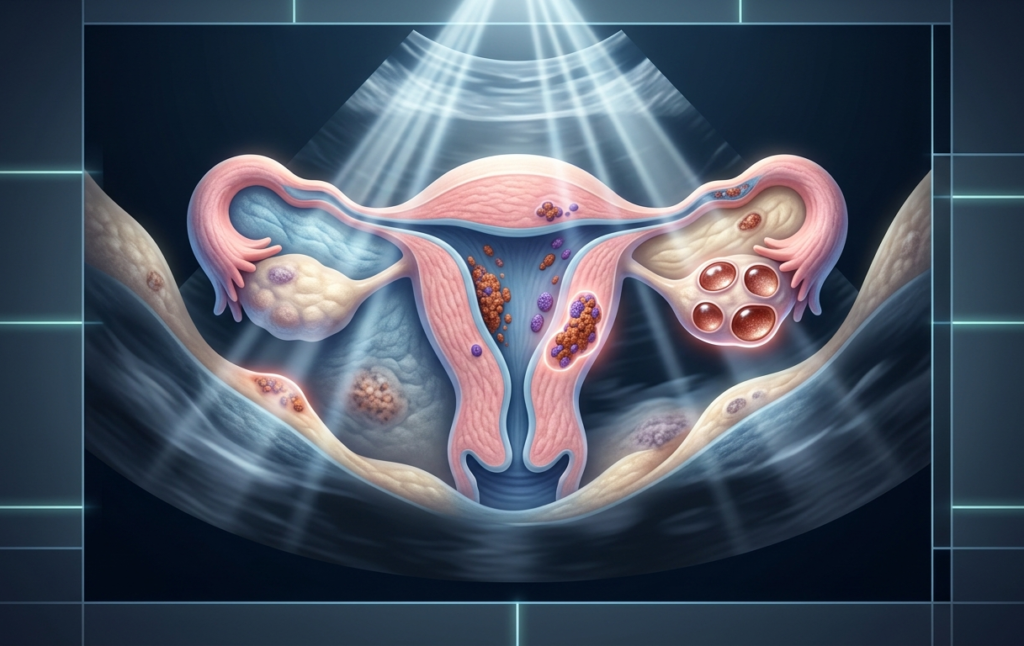
A prevalent gynecological condition called endometriosis causes tissue resembling the lining of the uterus to grow outside of it. Endometriosis can be challenging to identify since its signs and symptoms often align with those of other reproductive conditions. An endometriosis ultrasound is the first imaging technique that specialists might suggest.
Ultrasound is an important diagnostic procedure for detecting ovarian cysts, deep penetrating disease, and abnormalities that could point to endometriosis, even when it is not able to detect every case of endometriosis.
Patients can gain insights on what to expect throughout the diagnostic procedure and the reason why further testing can sometimes be required to understand and treat the disease promptly while knowing the difference between endometriosis ultrasound vs normal.
Endometriosis Ultrasound: Explained
An endometriosis ultrasound is a non-invasive imaging diagnostic technique that generates images of the pelvic organs with extremely high frequency sound waves. Ultrasound is often used by specialists to evaluate:
- The uterus and the ovaries
- Fallopian tubes (when evident)
- The pelvic region
- Around reproductive organs
The underlying abnormalities can be identified by these ultrasound scans which can be responsible for signs and symptoms like fertility health issues, heavy menstrual bleeding, challenging periods cycle, and pelvic discomfort.
Can Endometriosis be Diagnosed by Ultrasound?
If a conventional ultrasound can identify endometriosis by itself, is one of the frequently asked concerns by women. But it’s not always the case.
Ovarian endometriomas, also referred to as, “Chocolate cysts” and some deep penetrating lesions, are two different characteristics of endometriosis that ultrasound is efficient at detecting.
Yet, endometrial implants that are either superficial or tiny, are usually too small to be identified by ultrasonography. Due to this, if symptoms clearly indicate the endometriosis, sometimes a standard ultrasound scan fails to entirely rule it out.
Experiencing symptoms of endometriosis? Get expert evaluation and explore personalized endometriosis treatment options. Learn More About Endometriosis Treatment →
Types of Ultrasounds
1. Transviginal Ultrasound
When endometriosis is believed to exist, this type of ultrasound is mostly done. In order to obtain the high quality and precise imaging of the uterus and ovaries, a tiny probe for ultrasound is placed inside the vagina.
Pros are;
- High resolution imaging
- Improved visualization of the pelvic organs
- Enhanced detection of the ovarian cysts
- More accurate and precise assessment of the pelvic anatomy
2. Transabdominal Ultrasound
The probe of the ultrasound is positioned over the lower abdomen to conduct a transabdominal examination.
Though helpful, it is often employed in combination with transvaginal ultrasound and usually produces less detailed images.
What Appears in an Endometrial Ultrasound
A qualified specialist including gynecologist or radiologist can identify a variety of symptoms that indicate towards endometriosis. Among these are;
1. Ovarian Endometriomas
Such cysts are often linked to endometriosis and carry old blood. They usually show on ultrasonography as;
- Cysts with thick walls
- Consistent internal echoes
- “Ground glass” appearance
2. Deep Endometriosis
Ultrasound could reveal deep penetrating lesions in some women that effect;
- Pelvis ligaments
- The rectovaginal septum
- Bladder
- Bowel movement
The expertise of the medical professional who can perform the scans, can often determine the diagnosis accurately.
3. Pelvic Adhesions
The normal movement of the pelvic organs can be hindered by scar tissue formed due to chronic inflammation.
Expert ultrasound professionals can detect even tiny signs that can suggest adhesions.
Endometriosis Normal vs Ultrasound
Understanding the difference between endometriosis ultrasound and normal, aids in knowing whether imaging is essential for diagnosis or not.
1. Normal Ultrasound
An ultrasound imaging of healthy pelvis typically shows;
- Ovaries of the normal size
- Smooth surface of the ovaries
- No ovarian cysts
- A healthy uterus
- Pelvic organs are able to move freely
- No anomalies
2. Endometriosis Ultrasound
An ultrasound that indicates endometriosis shows;
- Ovarian cysts or endometriomas
- Severe adhesions
- Distorted pelvic anatomy
- Deep infiltrate nodules
- Weak organ mobility
- Signs of acute pelvic inflammation
However, many women with mild endometriosis have completely normal ultrasound scans.
Why Can Ultrasound Not Detect Every Case?
One common misconception is the belief that endometriosis can not be detected in a normal ultrasound.
In reality, usually small superficial implants and microscopic lesions are not visible in normal ultrasounds that can be mistakenly ruled out as normal even though being early stage disease. As a consequence of this, medical professionals evaluate ultrasounds along with symptoms, standard physical examinations and medical records.
Signs That May Lead to An Ultrasound
An ultrasound could potentially be suggested by your doctor if you have the following experience;
- Severe menstrual cramps
- Persistent pelvic pain
- Pain during intercourse
- Heavy bleeding during periods
- Infertility
- Constant ovarian discomfort
Imaging assists in determining potential causes and facilitates additional assessment.
Does Ultrasound Help in Fertility Assessment?
Indeed.
When assessing the fertility health, ultrasound is essential because it can determine;
- Ovarian reserves
- Ovarian tumors
- Abnormalities in the uterus
- Follicle development
- Thickness of the endometrium
This helps in formation of tailored treatment strategies by fertility health specialists.
Advanced Endometriosis Care at Top Fertility Facility
At NJINSKY IVF & Fertility Clinic, women with endometriosis signs and fertility issues could profit from a thorough diagnostic evaluation. To identify the root cause of infertility and pelvic discomfort, this clinic offers advanced reproductive ultrasound imaging, fertility evaluation tests, monitoring of the ovulation, and individual consultations.
NJINSKY IVF & Fertility Clinic formulates personalized treatment regimens by integrating the expertise of radiologists, gynecologists, and other fertility health professionals with advanced treatment technologies. To effectively boost the fertility results, the clinic additionally provides ovulation induction, IVF, ICSI, IUI, and other advanced reproductive treatments, based on each person’s medical records.
Lastly
An endometriosis ultrasound is generally one of the first steps in examining patients with pelvic pain, infertility, or probable endometriosis. Ovarian endometriomas and some deep infiltrated forms of the disease can be found using ultrasonography, though not all cases can be found with this method. Patients are better able to understand that a normal scan does not always rule out endometriosis.
For women with chronic symptoms, consulting a skilled gynecologist or fertility specialist in a renowned clinic like NJINSKY IVF & Fertility Clinic, is necessary. Ultrasound is crucial for obtaining an accurate diagnosis and directing successful treatment when paired with a comprehensive clinical evaluation and, if required, further imaging or laparoscopy.