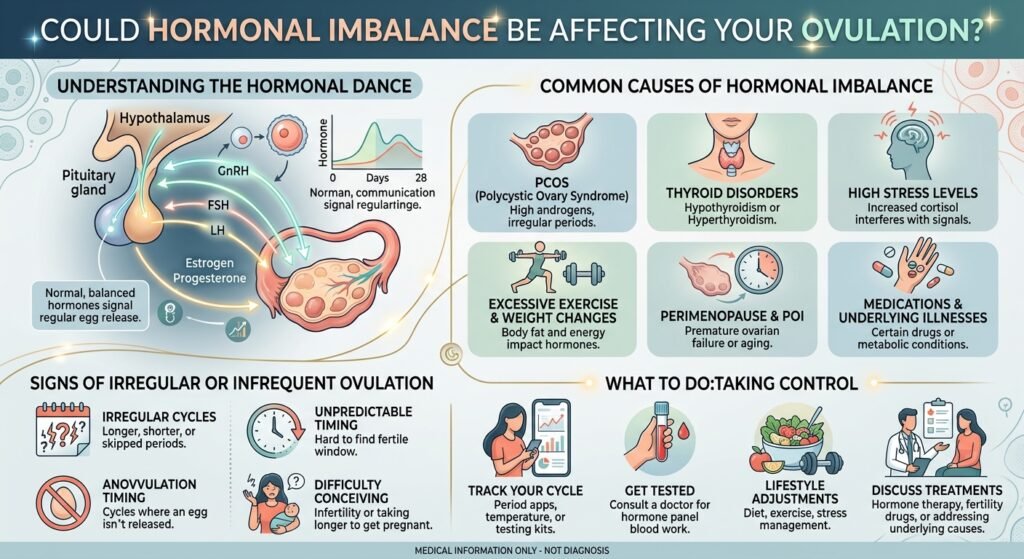
A carefully planned and regulated communication between your nervous system, pituitary gland, the ovaries, and the reproductive hormones is essential for every menstrual cycle. If this communication is disrupted, an egg may fail to develop properly or be released at the right time. This is where hormonal imbalance becomes an important factor in ovulation disorders.
No single hormone can trigger ovulation on its own. A variety of hormonal signals prepare the ovary for egg release, particularly luteinizing hormone (LH), follicle-stimulating hormone (FSH), estrogen, and progesterone. Problems with these hormones can lead to irregular or absent ovulation and, as a result, infertility.
Polycystic ovary syndrome (PCOS) is among the most common causes of ovulatory dysfunction, but it is far from the only one. Healthy ovulation can also be impaired by thyroid disorders, elevated prolactin levels, weight changes, excessive physical activity, pituitary and hypothalamic disorders, and other endocrine conditions.
Common Hormonal Causes of Ovulation Disorders
So, which hormones can actually interfere with ovulation?
The answer involves more than simply hormone levels being too high or too low. The timing and balance of hormonal signals influence ovulation, and a shift in even a single hormone can affect the entire reproductive system.
Polycystic Ovary Syndrome (PCOS)
PCOS is one of the most common causes of ovulation disorders. It typically involves a combination of polycystic ovarian morphology, elevated androgen levels, and irregular ovulation. Insulin resistance and altered hormonal signaling can impair both ovulation and follicular growth. As a result, women with PCOS may experience irregular or prolonged menstrual cycles, acne, excess body and facial hair growth, and difficulty getting pregnant. However, not every woman with PCOS has the same hormonal profile, and symptoms can vary significantly from person to person.
Problems with Thyroid Hormones
Although the thyroid gland may seem unrelated to reproduction, thyroid hormones play an important role in menstrual and reproductive function. Both underactive (hypothyroidism) and overactive (hyperthyroidism) thyroid conditions are linked to ovulatory problems and menstrual irregularities. For this reason, thyroid function is often evaluated in women with irregular periods or a suspected ovulatory disorder.
Increased Prolactin Levels
Prolactin is best known for its role in breast development and milk production, but abnormally high prolactin levels (hyperprolactinemia) can disrupt the hormonal signaling required for healthy ovarian function. This can lead to irregular or absent periods and difficulty conceiving.
Pituitary and Hypothalamus Hormonal Changes
The hypothalamus and pituitary gland serve as key control centers for reproduction.
Gonadotropin-releasing hormone (GnRH), released by the hypothalamus, signals the pituitary gland to produce FSH and LH, which in turn act on the ovaries. If this communication pathway is disrupted, ovulation can become irregular or stop altogether.
Functional hypothalamic disorders can develop from significant weight loss, inadequate energy intake, excessive exercise, and other physical or emotional stressors.
Resistance to Insulin and Excess Androgen Levels
Although women naturally produce androgens too, these hormones are often referred to as “male hormones.” Problems can arise when androgen levels become too high or their normal balance is disrupted. In PCOS, insulin resistance and elevated insulin levels are associated with increased ovarian androgen production, creating a hormonal environment that interferes with ovulation and healthy follicular development.
Warning Signs of Hormonal Imbalance
Hormonal changes don’t always cause obvious symptoms. Often, the first sign is simply that your monthly cycle stops behaving the way it used to. Hormonal dysfunction linked to ovulation disorders can show up as the following signs and symptoms:
- Irregular or infrequent menstrual cycles
- Prolonged gaps between periods
- Completely missed menstrual cycles
- Difficulty getting pregnant
- Frequent acne breakouts
- Excessive hair growth on the body and face
- Thinning of scalp hair
- Unpredictable weight changes
- Unexpected or excessive menstrual bleeding
A hormonal problem isn’t always defined by a single symptom. For example, acne or changes in hair growth can occur without an ovulation disorder, while menstrual irregularities can have a variety of causes.
How Hormonal Imbalance May Be Affecting Fertility?
This is where understanding hormone function becomes especially important. For ovulation to occur, a follicle must develop, grow, and ultimately release a mature egg. This process depends on well-regulated hormonal signaling.
When hormonal signaling is disrupted, a dominant follicle may fail to develop properly, and the egg may not be released at all. In some women, ovulation happens only occasionally; in others, it may stop entirely during unusually long cycles. Because pregnancy requires a fully matured egg, this is critical for fertility.
If ovulation occurs only occasionally, the chances of conceiving in a given month are lower, and natural conception can’t happen at all during a cycle without ovulation. Hormonal issues can also make it harder to predict the fertile window, and even with careful cycle tracking, a woman may be unable to pinpoint when ovulation occurs.
It’s also worth noting that regular menstrual cycles don’t always mean ovulation is adequate. If fertility problems persist, further evaluation may be needed, since ovulatory dysfunction can sometimes occur even when cycles appear predictable.
Diagnosis and Treatment of Hormonal Imbalance in Ovulation Disorders
Identifying the underlying cause is the first step in diagnosing and treating hormonal imbalances related to ovulatory disorders. A healthcare provider will typically ask about the following:
- The length and regularity of your menstrual cycle
- Fertility issues and previous pregnancies
- Weight changes
- Exercise and dietary habits
- Medications
- Persistent acne, excessive hair growth, or hair loss
- Family medical history
Blood tests may be used to assess hormone levels such as prolactin, thyroid-stimulating hormone (TSH), androgens, and other reproductive hormones, depending on the clinical picture. When PCOS is suspected, diagnosis involves evaluating features such as hyperandrogenism and ovulatory dysfunction while ruling out other conditions that can cause similar symptoms.
Current diagnostic guidelines recognize that the presence of multiple ovarian follicles on ultrasound alone is not enough to diagnose PCOS. Pelvic ultrasound can still be useful for assessing the ovaries and uterus more broadly. Additional hormonal tests, such as progesterone testing and follicle-tracking ultrasounds, can provide further information when confirmation of ovulation is needed.
When Should You Seek Help?
One or two occasional irregular cycles rarely indicate a problem. However, a professional evaluation is warranted if you experience persistent menstrual irregularities, long gaps between periods, probable anovulation, or difficulty getting pregnant.
In light of their medical history and fertility targets, women with ovulatory and standard fertility issues can undergo a tailored reproductive evaluation and treatment at NJINSKY IVF & Fertility Clinic. If clinically reasonable, alternative treatment options might consist of ovulation regulation and assisted reproductive procedures like IVF and IUI.
Fully understanding your hormones isn’t about chasing a “perfect” hormonal level. It’s about learning how the different parts of the reproductive system communicate with each other and identifying why that communication may be disrupted.
Conclusion
Is a hormonal imbalance affecting your ovulation?
Hormonal changes can disrupt ovulation, leading to menstrual irregularities and difficulty getting pregnant. Thyroid problems, PCOS, and elevated prolactin levels are among the possible contributing factors. Identifying the root cause is the first step toward getting the right treatment. If abnormal menstruation or reproductive problems persist, consulting a specialist or gynecologist can help you understand what’s happening and explore appropriate treatment options.